Graded vinyl is selling at auction roughly twelve times as often as two years ago. What that does, and does not, tell you about price is the more useful story.
Key takeaways
- Graded vinyl sold at auction about twelve times as often in 2026 as in 2024, in Goldin’s public sold-lot archive, and the year is not over.
- The pressing drives price more than the artist, the year or the grade. For five of the nine albums that sold often enough to compare, the cheapest and dearest copy were more than 20 times apart.
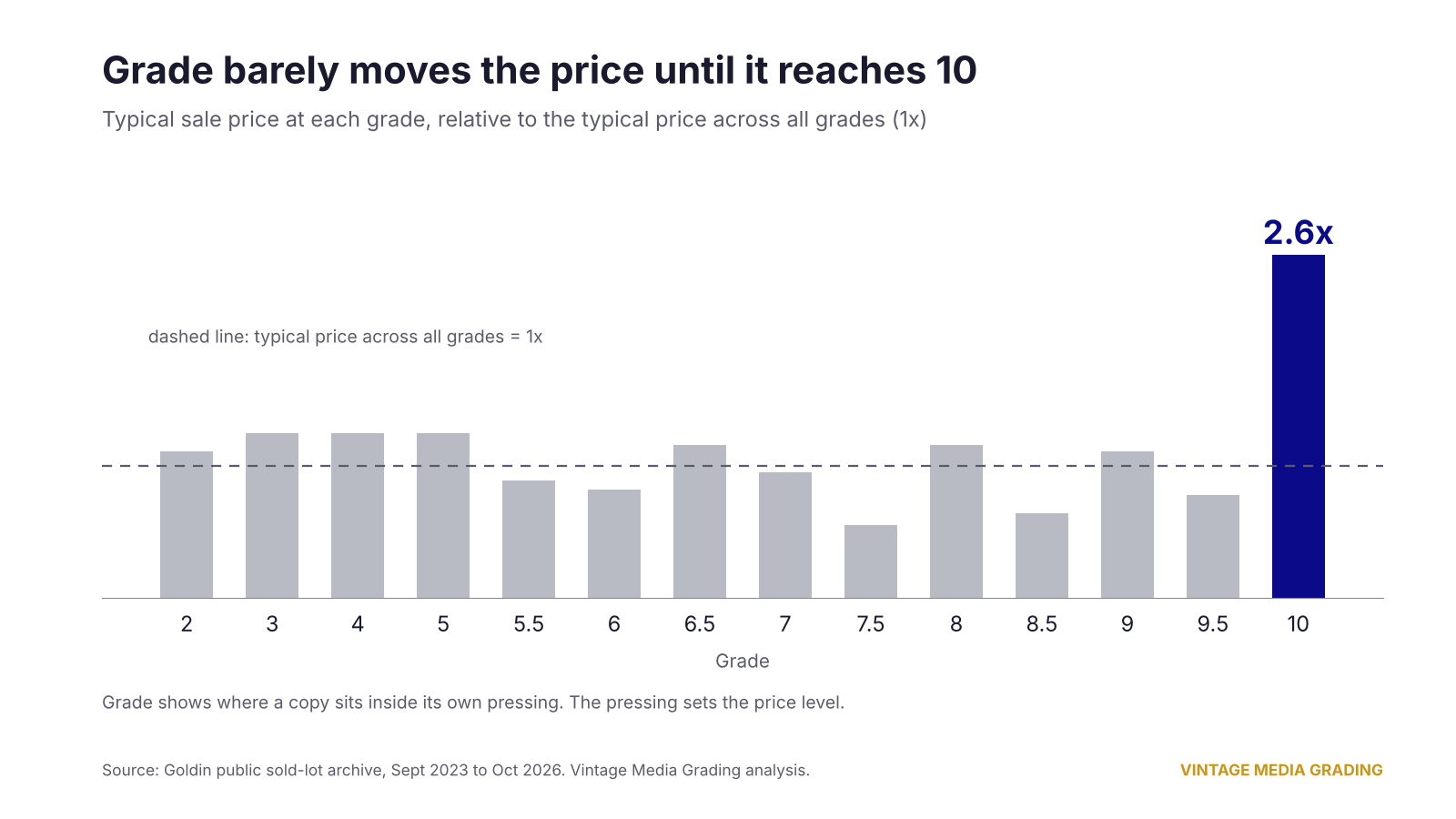
- Across the market, grade moves price less than most people expect. Typical prices are roughly flat up to a 9.5, and only a perfect 10 pulls away.
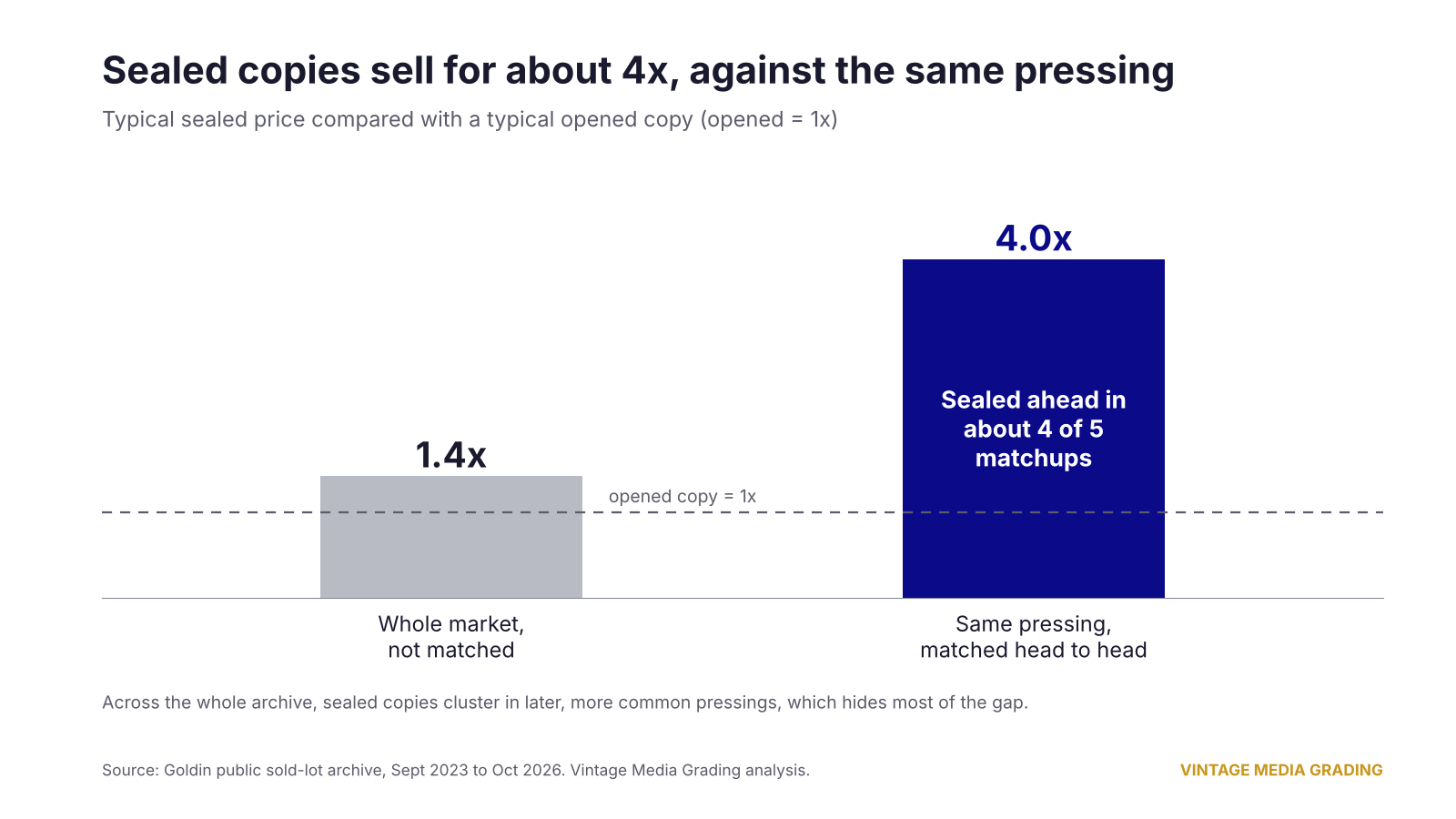
- Against the same pressing, a sealed copy sold for roughly four times as much as an opened one.
- Promotional copies are not automatically worth more, and quarterly average prices are a poor guide to the market.
The graded vinyl category is growing fast
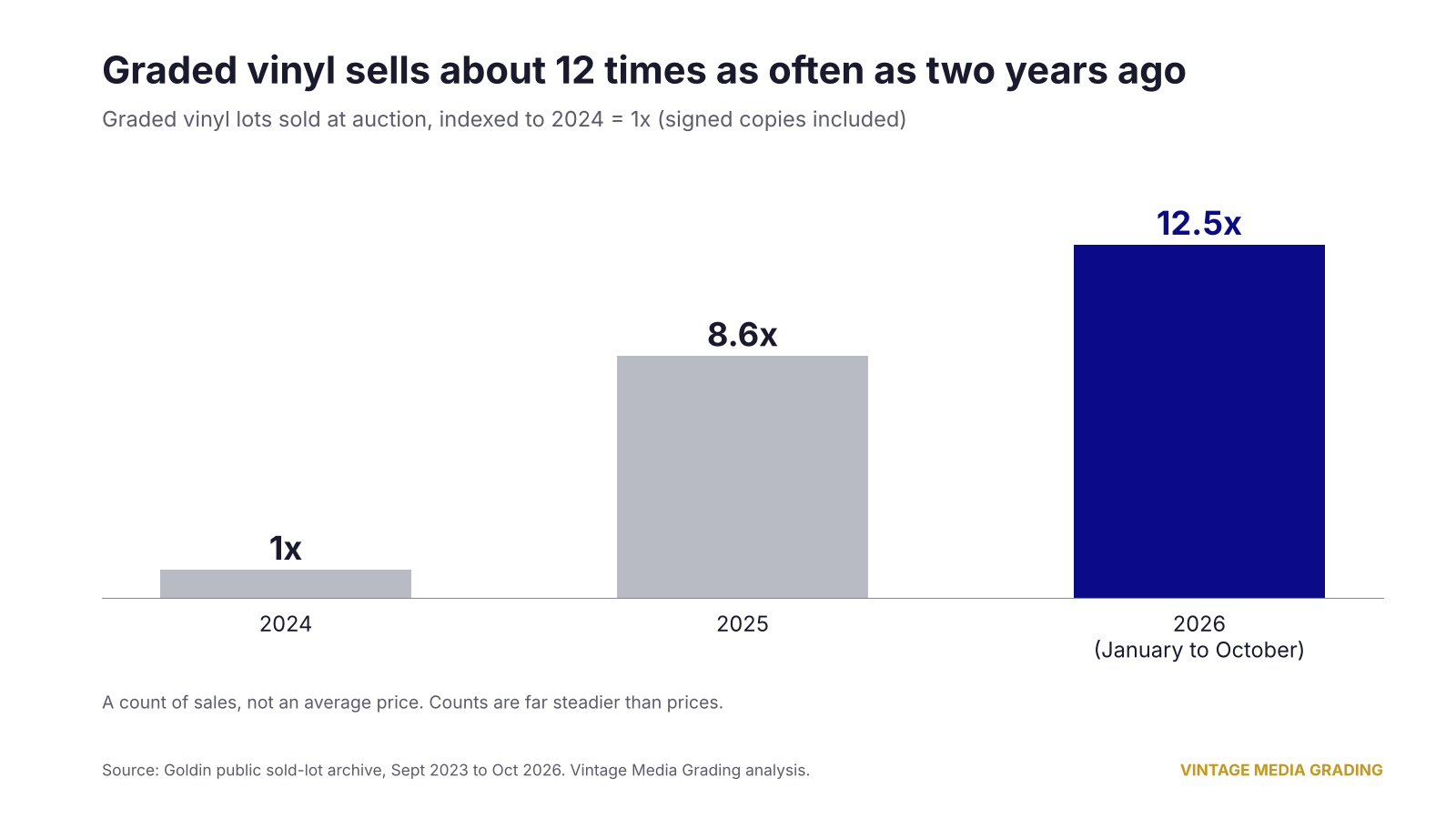
In Goldin’s public sold-lot archive, graded vinyl records sold roughly twelve times as often in 2026 as in 2024, and the year is not over. That count includes signed copies.
Volume is the most dependable number in this market. An average price swings with whatever happened to be consigned that quarter; a count of sales does not.
Which pressing of a graded vinyl record matters most?
Every album gets pressed more than once: in different countries, at different plants, and again years later as reissues. Each run is its own pressing, and the cover and title can be identical across all of them. The price is not. In the data, the biggest driver of price is not the artist, the year or even the condition. It is which pressing a copy happens to be.
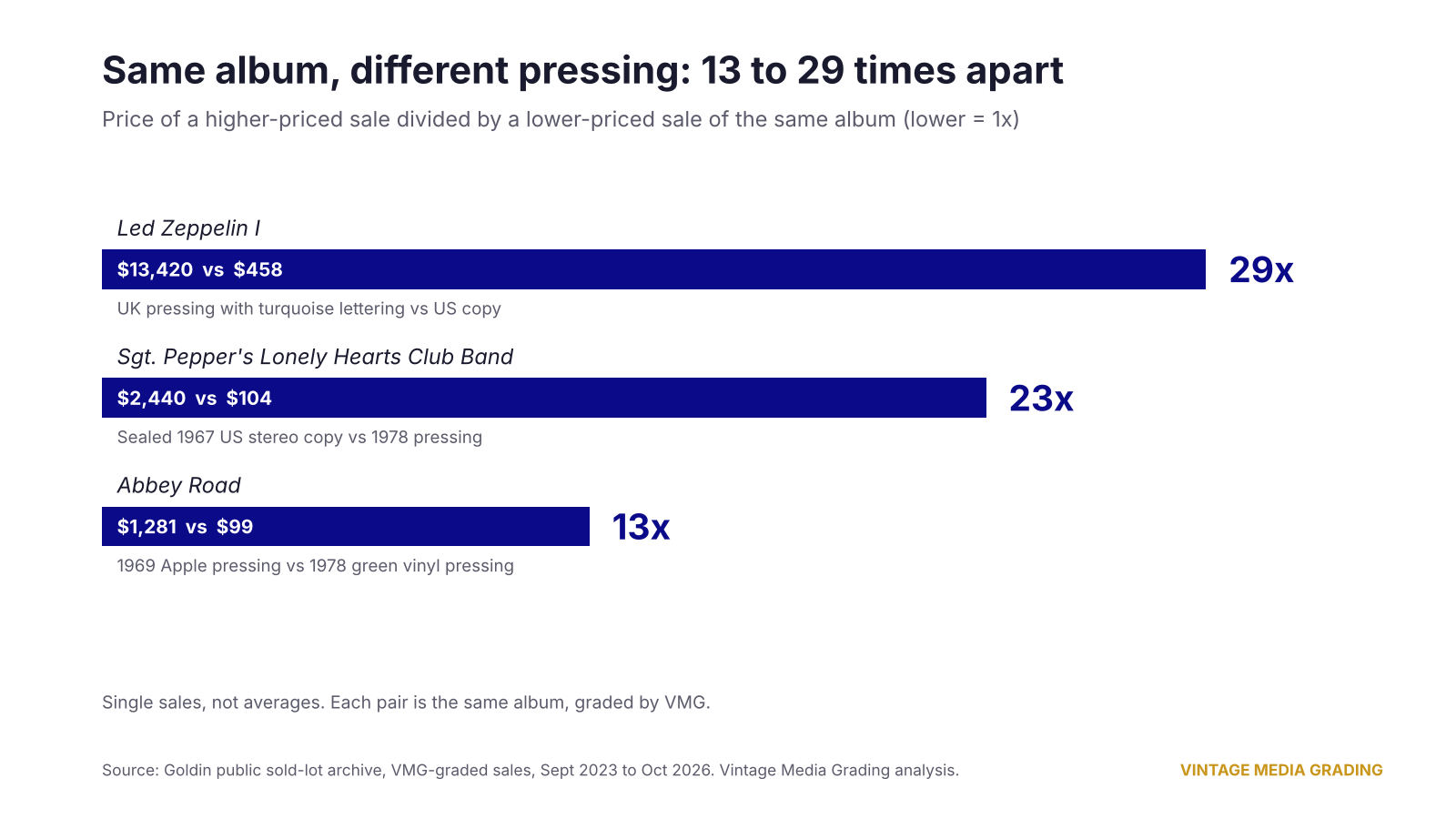
Three VMG-graded sales from Goldin’s public archive show how far apart two copies of the same album can land:
- Sgt. Pepper’s Lonely Hearts Club Band: a sealed 1967 US stereo copy, without the NEMS or Maclen credits, sold for $2,440 in May 2026. A standard 1978 pressing sold for $104 in July 2025. About 23 times apart.
- Abbey Road: a 1969 Apple pressing sold for $1,281 in May 2026. A 1978 green vinyl pressing sold for $99 in July 2025. About 13 times.
- Led Zeppelin I: a UK pressing with turquoise lettering sold for $13,420 in November 2025. A US copy with an RIAA Gold Record Award sticker sold for $458 in July 2025. About 29 times.
These are single sales, not averages, but the pattern holds across the archive: of the nine albums that sold often enough to compare, five spread by more than 20 times between their cheapest and dearest copy.
The title on the spine can’t tell you which pressing you have. The catalogue number, the matrix codes etched into the runout, and a few physical details can.
Condition matters, inside a pressing
Across the whole market, grade moves price less than most people expect. From the lowest grades up to 9.5 the typical sale price is roughly flat, and only a perfect 10 pulls away.
That is not because condition does not matter. It is because grade is measured within a pressing. A worn copy of a scarce original routinely outsells a flawless copy of a common reissue. Establish the pressing first; the grade then tells you where that copy sits in its range.
Sealed copies sold for about four times as much, against the same pressing that is opened
Across the whole archive, a typical sealed record sold for only about 43% more than a typical opened one. That figure hides most of the story, because sealed copies cluster in later, more common pressings.
Compare sealed and opened copies of the same pressing and the gap is roughly four times, with the sealed copy coming out ahead in about four of every five matchups.
The graded market is still young, and right now buyers are rewarding sealed copies. That leaves opened records in strong condition selling at a steep discount to sealed copies of the same pressing. As the category matures, we see real room for opened records to gain ground.
Promos are not automatically worth more
Matched against retail copies of the same album, promotional copies sold in line with them: ahead about as often as behind, which is a coin flip.
Test pressings are a different market. They skew high and are scarce, but too few have sold to say much about pricing with confidence. Acetates barely trade at all but that is inherent in what they are, they’re aren’t many at all of them out there. However, they do surface and they do sell as long as the acetate has notoriety. A VMG-graded Beatles “Penny Lane” acetate sold for $9,760 in May 2026.
Why price trends in auction data mislead
It is tempting to read quarterly averages as a market index. They are not one. A quarter that happens to include a large consignment of ordinary records looks like a crash; a quarter with a few scarce ones looks like a boom.
In the data behind this article, the same auctions, in the same months, showed typical prices rising in one grading company’s lots while they fell in another’s. No market-wide move produces that. If someone quotes you a percentage that graded vinyl moved last quarter, they are most likely reading a change in what was consigned.
Where to start with your own records
Begin with the facts that identify a record: the catalogue number, the matrix codes in the runout, and the hallmarks that separate one variant from another. Check them before you read anything into the cover.
VMG states those facts for each record it grades: artist, album, date, catalogue number, matrix codes, important hallmarks, and the variant’s name where it has an established one. It authenticates the record and grades the sleeve and the vinyl separately. The evidence stays with the record.
Two free tools on our site can help before you spend anything:
- The population report. Our population report lists the records VMG has graded and how they came out. Search an artist or album to see what has already been slabbed and where the gaps are: titles with few graded copies, or pressings nobody has submitted yet. If you have a VMG slab, you can also look it up by certification number.
- The grading rubric. The VMG grading rubric sets out how each grade is assigned, criterion by criterion, for open and sealed albums. Hold your copy up against it for a rough idea of where it would land. The final grade is set when we inspect the record.
To see how graded records trade in practice, search VMG on goldin.co. And if you are new to collecting, our free Collecting Vinyl Records 101 ebook covers the basics.
Grading a few records from your own collection? Start on our services page and choose your format: 12″, 7″ or LaserDisc. Fill out the submission form with what you know about each record. If you are unsure of a detail, do your best; that is part of what we are here for. Then pack your records securely with your packing slip and send them in. We log them when they arrive, authenticate and grade them, encase them in a VMG slab and ship them back, and you can follow each step online.
One note: VMG grades condition and authenticates records. We do not appraise or put a price on them, so the auction data above is context for how the market behaves, not a valuation of your copy.
Auction houses: if you consign collectible vinyl records, VMG can partner with you for bulk submissions and additional support. Contact us to talk through what would work for your consignors.
About the data: this article draws on Goldin’s public sold-lot archive, September 2023 through October 2026, and covers unsigned graded vinyl records, apart from the volume figure above. It describes the market as a whole, not any single grading company’s results. The named examples are individual VMG-graded sales; the statistics cover all graded vinyl in the archive.
Graded vinyl auction data: frequently asked questions
How much faster is graded vinyl selling at auction?
In Goldin’s public sold-lot archive, graded vinyl records sold roughly twelve times as often in 2026 as in 2024, and the year is not over. The count includes signed copies.
Does the pressing or the grade matter more to the price of graded vinyl?
The pressing. Across the whole market, grade moves price less than most people expect, because grade is measured within a pressing. A worn copy of a scarce original routinely outsells a flawless copy of a common reissue.
Do sealed records sell for more than opened ones?
Yes, but the gap depends on what you compare. Against the same pressing, a sealed copy sold for roughly four times as much as an opened one, and came out ahead in about four of every five matchups.
Are promotional records worth more at auction?
Not automatically. Matched against retail copies of the same album, promotional copies sold in line with them, ahead about as often as behind.
Does VMG appraise records?
No. VMG grades condition and authenticates records. It does not appraise them or assign a value.