

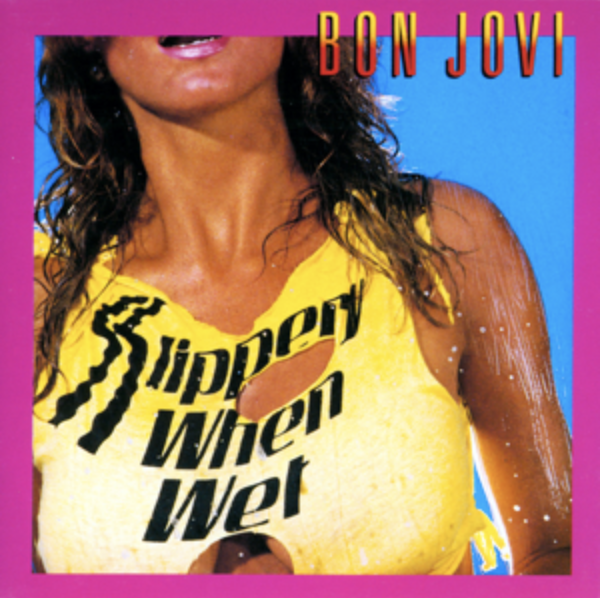
Bon Jovi’s Slippery When Wet is best known for a cover the band never wanted: water traced across a wet black bin bag. The one they did want — a woman in a soaked yellow T-shirt — was pulled before release, but it reached shops anyway in several countries, and in three different border colors.
Here’s how to tell the pressings apart.
Which cover do you have?
Start with the artwork, then confirm with the catalog number. The two US pressings share a catalog number, so the sleeve is what separates them.
| Pressing | Catalog number | Cover | How to confirm it |
|---|---|---|---|
| US — common | 422-830 264-1 M-1 (also 830 264-1 M-1) | Wet black bin bag, title traced in the water | Indianapolis pressings carry a yellow inner sleeve |
| US — wet T-shirt | 830 264-1 M-1 | Wet T-shirt, pink border | Scarce. Confirm against the Japanese copy using the text along the bottom of the back cover, and the barcode position |
| UK | VERH 38 / 830 264-1 | Wet black bin bag, blue logo, title printed on the front | Blue BON JOVI logo with a red outline; labels read Made In England; TapeOne in the runout |
| Japan | 28PP-1025 | Wet T-shirt, pink border | Obi strip; Japanese title ワイルド・イン・ザ・ストリーツ; barcode sits in a different place from the US copy |
| France, Netherlands, Canada | 830 264-1 (France) | Wet T-shirt, silver border | Silver border rather than pink; no M-1 suffix on the French catalog number |
If the obi is missing from a Japanese copy, the catalog number on the back cover still identifies it. The obi is a separate piece of paper and it goes missing far more often than it survives.
The cover that almost didn’t ship
The band submitted a photograph of a woman in a wet yellow T-shirt with the album title written across it. The label refused it. The concern was that the big American record chains wouldn’t stock it, and Jon Bon Jovi had his own objection — he disliked the bright pink border around the photograph.
Richie Sambora later said the label “freaked out a bit” and that something else had to be found quickly. What they found was a bin bag.
The replacement was shot at photographer Mark Weiss’s New York studio, and it was as improvised as it looks. Jon Bon Jovi arrived with the idea — a garbage bag and a spray bottle. The band held the bag taut, Weiss sprayed it with water, and Jon traced the title into the beading by hand. Sambora has described it since as a Hefty trash bag with water sprayed on it. The finished photograph was delivered the next day.
The T-shirt never entirely disappeared. Japan released it, so did France, the Netherlands and Canada, and a small number of US copies carry it too. A third option never made it at all: a photograph of the band dressed as cowboys, which resurfaced on the “Wanted Dead or Alive” single.
The US pressings — two covers, one catalog number

The common American release carries the image everyone knows: Slippery When Wet traced by hand in the water pooling on a wet black bin bag. Sambora’s assessment was blunt — “so simple, and not very impressive.” It shipped in enormous numbers, which makes it easy to find and hard to find clean.
A US pressing with the wet T-shirt cover and a pink border also exists, and it is far scarcer. Because it shares the 830 264-1 M-1 catalog number with the common pressing, the number on the spine won’t tell you which one you have — the sleeve will.
Three details settle it without needing a second copy for comparison. The withdrawn pressing shipped with a red inner sleeve, where the common one came with a yellow one. Its barcode reads 0 422-830264-1 4. And both sides were cut at Sterling Sound using Direct Metal Mastering, so the runout carries a Sterling Sound stamp alongside a DMM mark. The back cover reads 1986 PolyGram Records, Inc., Made in USA.
The UK pressing — same photograph, different logo
The UK release is easy to overlook, because the photograph on the front is the same one. The lettering is not. On the US sleeve the BON JOVI logo is red with a white outline, and the album title appears nowhere on the front at all — it exists only as the handwriting in the water. The UK Vertigo sleeve puts the logo in blue with a red outline, and prints SLIPPERY WHEN WET in the same blue across the bottom of the cover.
It is a small change, and in a low-resolution listing photo it is easy to miss. Side by side the two sleeves read quite differently, and a UK copy is often sold as though it were the US pressing simply because nobody looked at the logo.
The rest of the identifiers are straightforward. The UK pressing is Vertigo VERH 38, carrying the Phonogram number 830 264-1 and barcode 042283026414, and the labels are printed Made In England. It shipped with a picture-lyric inner sleeve. It was mastered at Sterling Sound by George Marino and the lacquers were cut at Tape One in London, so a UK runout carries a TapeOne stamp alongside the VERH 38 matrix — which is the quickest confirmation if the sleeve has been swapped.
The Japanese pressing

Japan released the T-shirt cover, pink border and all, on Mercury 28PP-1025, dated 10 August 1986. It arrived with two things the US copy never had: an obi strip and a Japanese-language insert.
Telling a Japanese copy from the withdrawn US one takes more than the front cover, because both carry the T-shirt and the pink border. The identifiers settle it in seconds. The Japanese pressing is Mercury 28PP-1025, its barcode reads T4988 011 30148 3, the rights society is JASRAC and the obi carries a ¥2,800 price. The withdrawn US copy is 830 264-1, its barcode reads 0 422-830264-1 4, and the rights society is ASCAP. Japanese runouts are stamped rather than etched, reading 28PP-1025A and 28PP-1025B with a trailing stamper number.
Which obi do you have?
Every Japanese copy carries the same catalog number, so the obi is what separates them from each other — and because the obi is the first thing most owners threw away, it is also most of what separates their values. Four turn up:
- White obi. The initial first pressing.
- Yellow obi reading 来日記念盤, the Japan Tour commemorative. Also a first pressing, issued with a liner-note insert carrying Japanese and English lyrics and a printed personal message card signed by the band.
- The same commemorative obi with a red 見本盤 promo sticker on the sleeve and obi, and promo characters on the labels. This is the promo version of that first pressing.
- A later revised yellow obi carrying 全米No.1! — number one in America. New insert, and no message card.
Both the obi and the insert matter for condition. The obi is a narrow paper band that wraps the sleeve, and it is the first thing to be thrown away, torn or lost. A complete Japanese copy means sleeve, obi and insert — and that completeness is part of what a grader records.
The track that isn’t on the sleeve
One quirk runs through all of them and makes a Japanese copy easy to confirm. There are no track times anywhere — not on the sleeve, not on the center labels. And the album does not open with the song the sleeve says it does. The first track is Pink Flamingos, an instrumental credited on the A-side label and in the insert but left off the sleeve entirely. If the sleeve and the label disagree about track one, you are holding a Japanese pressing.
The silver-border pressings

France, the Netherlands and Canada got the T-shirt cover with a silver border instead of a pink one, which makes it the easiest variant to spot across a room. The French pressing is Mercury 830 264-1, without the M-1 suffix the US copies carry.
Collecting the set

Four covers sounds like a straightforward chase, and it is — until condition enters the picture. The common US copy is everywhere and rarely clean. The Japanese copy is harder to find complete than it is to find at all. The same pattern runs through the vinyl collectibility of Guns N’ Roses, where the common pressing is everywhere and the clean one is not.
If you’re assembling a set, the thing that separates copies isn’t rarity. It’s whether the sleeve corners are square, whether the obi survived, and what the vinyl looks like under proper light.
Still not sure which one you have?
This article gets you most of the way. The border color and the catalog number separate the four pressings, but the last stretch — the text along the bottom of the back cover, the matrix codes stamped in the runout, the true condition of a sleeve that has been in a crate since 1986 — is what actually settles it.
That’s the work VMG does. We document the facts that identify your exact pressing — artist, album, date, catalog number, matrix codes and the hallmarks that separate one variant from another — grade the sleeve and the vinyl in half-point increments, and seal the record in a tamper-evident holder with a QR code linking to its own certification page. Every copy we grade is listed on the VMG population report, so you can see how yours sits against everything else that has been graded.
We won’t tell you what it’s worth — that isn’t what grading is. If that’s the question on your mind, our graded vinyl auction data shows what graded copies have actually sold for.
Find out which pressing you have →
More on grading and collectibles
Jeremy Padawar joins the VMG podcast to talk about grading, authentication and where collectibles are heading.
One Response
Interesting article, although the black cover didn’t have the album title sprayed onto a rough surface – water was sprayed onto a black refuse sack and Slippery Whe Wet was written on it with a finger.
I notice that colour differences are included as different sleeves but the original UK sleeve wasn’t mentioned in the article. This was the same as the standard black sleeve but the Bon Jovi logo was in blue and red instead of white and red.
It isn’t a big difference but it does change the aesthetic of the sleeve.
Images of it can be seen here https://www.discogs.com/release/16161561-Bon-Jovi-Slippery-When-Wet